How can procurement rules and criteria be redesigned to speed up sustainability across the built environment? This article sets out how public and private buyers can use whole-life thinking, at both project and product level, to drive demand for low-carbon, resilient buildings and materials.
By Dr Andrew Minson and Nicolas Antoniou, Global Cement and Concrete Association
Photo: Pexels
Sustainable procurement in buildings and construction can accelerate climate action and transform markets. By redesigning procurement rules to prioritise whole-life carbon, resilience and value over lowest upfront cost, buyers can stimulate demand for low-carbon materials, energy-efficient design and innovative construction. Strong sustainability criteria send clear market signals, scale up ambition and speed the transition to low-carbon, resilient buildings.
1. Introduction
Public and private procurement can transform the construction sector by creating strong, sustained demand for low-carbon and resilient buildings and materials. Governments, public authorities and large private developers account for a large share of construction demand worldwide. Their procurement policies are well placed to influence supply chains, speed up innovation and scale sustainable solutions.
Traditional construction procurement often favours the lowest upfront cost. This can discourage investment in low-carbon materials, resilient design and new construction methods. By redesigning procurement to consider whole-life value and environmental performance, buyers can grow the market for sustainable products and practices.
Every construction project also has a stage where individual products and materials are bought. Procurement frameworks must therefore cover both whole-project performance and product-level procurement, so that material choices support lifecycle outcomes.
This article refers to embodied and operational emissions. Embodied emissions come from making construction materials, transport, construction, future maintenance or replacement, and end-of-life treatment. Operational emissions come from the energy used to heat, cool, light and run a building or infrastructure asset over its life. Good procurement should assess both together and understand how they interact, so that design choices optimise overall lifecycle carbon rather than treating each in isolation.
This article does not cover every aspect of whole-life procurement. It highlights key points for whole-life project and product procurement, specifically:
- Whole-life, whole-project emissions from embodied and operational sources
- Whole-life, whole-project embodied emissions
- Product procurement
2. Whole-life, whole-project embodied and operational emissions
2.1 Service life
Service life is one of the biggest factors in whole-life emissions. Apart from short-lived temporary structures (covered below), durable materials can greatly reduce the annualised environmental impact of buildings and infrastructure. Concrete structures, for example, often achieve long service lives with relatively little maintenance, so the embodied emissions of their construction are spread over many decades.
Design decisions that extend service life can therefore improve lifecycle carbon performance. For instance, increasing the design life of a structural frame from 60 to 100 years may need a relatively small extra investment in embodied carbon at construction. Yet it can significantly reduce the building's annualised embodied and operational emissions over time. For some project types, clients may choose to prioritise extended service life as part of their sustainability strategy.
For short-lived temporary structures, the annualised calculation shows how significant upfront embodied emissions are, and confirms the benefit of reusing elements. Reuse in effect offsets the upfront impacts.
2.2 Building fabric and operational energy
Procurement should also consider how the building fabric interacts with operational energy. Cladding, insulation and structural materials all affect a building's thermal behaviour and so its operational emissions. Materials with high thermal mass, such as concrete, can moderate indoor temperature swings by absorbing heat and releasing it slowly. Designed in well, this can cut peak heating and cooling loads and lower operational energy demand. Material choice and thermal behaviour can also change how much building services equipment is needed, and the embodied carbon that comes with it.
3. Whole-life, whole-project embodied emissions
A building or infrastructure asset's structure often does more than carry loads. Whole-life procurement assessments should recognise these extra functions. For example, concrete floors, walls and frames can also provide:
- Architectural finishes, reducing the need for extra finishing materials
- Acoustic performance, improving sound insulation and comfort and reducing the need for extra finishes
- Fire resistance, reducing the need for extra fire protection
By doing several jobs at once, structural materials can cut the need for extra materials and layers, lowering the project's overall embodied carbon.
Procurement frameworks should also consider future adaptation, repurposing and upgrades. Structures with enough robustness, flexibility and capacity can take changes of use, extensions or new building systems without demolition or major structural work. This reduces the need for new materials and avoids large future embodied emissions.
End of life is also an important part of whole-life embodied carbon assessment. Materials may be reused, recycled or recovered when a building reaches the end of its life, supporting the circular economy. Lifecycle assessment captures these potential benefits in Module D, which reports the benefits of recovery and reuse beyond the system boundary. Recognising them lets procurement consider how today's material choices can support resource efficiency and carbon reduction in future construction.
4. Product procurement
Whole-building assessments are essential to understand lifecycle performance and to procure the lowest-impact projects. But at some point individual products must be bought, and that requires comparing their environmental performance.
For product procurement, it is common to compare products using Modules A1 to A3 of their Environmental Product Declarations (EPDs). These cover the embodied emissions of raw material supply, transport and manufacturing.
This is appropriate when comparing identically specified products that do the same job. In that case, lifecycle stages B1 to C (use, maintenance and end of life) will generally be similar whichever manufacturer is chosen. Module A4 (transport to site) is usually project-specific, depending on where the site and the factory are. It is often estimated at design stage and refined once suppliers are known.
Product procurement may focus on A1 to A3, but the other modules remain essential inputs to whole-life project assessments, as described in Section 3. At design stage, many impacts must be estimated before suppliers are chosen, so designers need representative data for transport (A4) and the use and end-of-life stages (B1 to C) to get a complete picture.
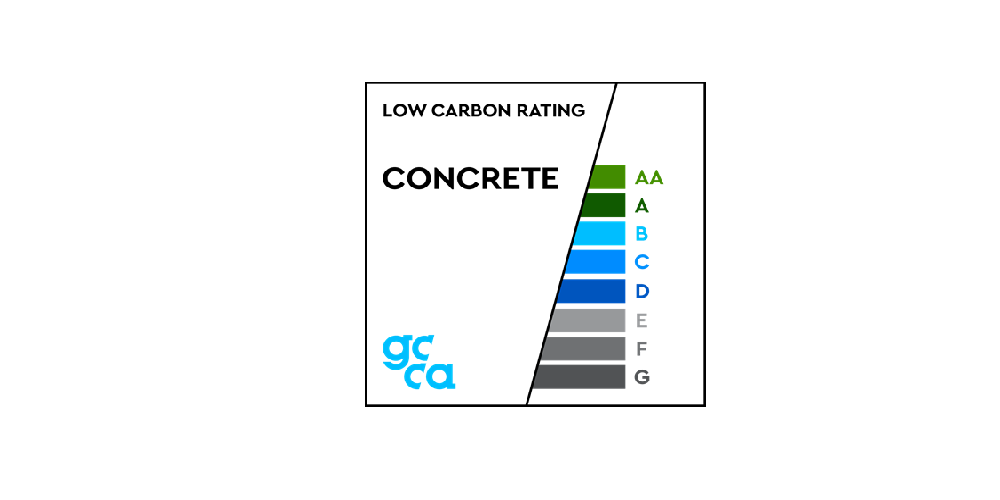
To support low-carbon product procurement, the cement and concrete industry has developed tools and benchmarks for transparent product comparison. The GCCA Low Carbon Ratings (LCR) give a clear, consistent way to rate the carbon intensity of cement and concrete products. Buyers can use them to set carbon targets or thresholds in procurement specifications.
By combining transparent product-level benchmarks with whole-life project assessment, procurement frameworks can send clear market signals that encourage lower-carbon construction materials while maintaining performance, safety and durability.