
Concrete naturally absorbs CO₂ over its life, offsetting part of its embodied carbon. This article explains how recarbonation is accounted for in EPDs today, how the GCCA EPD Tool (Version 6) models it, and why the next step is project-level accounting using BIM.
Global Cement and Concrete Association. Updated September 2026 to reflect the recarbonation method in Version 6 of the GCCA EPD Tool.

Photo: Pexels
1. Introduction
Recarbonation (or carbonation) is the natural process in which CO₂ from the air penetrates concrete and reacts with its hydration products to form carbonates. It partly "rebinds" the CO₂ released when clinker and cement are made, offsetting some of concrete's gross embodied carbon. As long as it does not reach the reinforcement, carbonation also slightly increases concrete strength.
Significant recarbonation can happen at several points in a concrete product's life: while precast elements are stored at the factory, throughout the service life of buildings and structures, and after demolition, when concrete is crushed, stored, recycled or landfilled. Because the amounts can be large, recarbonation should be reflected in whole-life carbon accounting for concrete products and buildings.
EN 15804 (core rules for construction product EPDs) and EN 16757 (Product Category Rules for concrete and concrete elements) provide a framework for transparent recarbonation accounting at product level. The GCCA EPD Tool follows these standards and offers three ways to estimate CO₂ uptake (detailed, default and user-defined) across modules A3 (precast storage), B (use), C3 (waste processing) and C4 (disposal).
This product-level approach has a built-in limitation. Producers rarely know the real exposure, surface area and service life of their concrete in a specific building, so they rely on generic scenarios and conservative defaults. This is right for product transparency, but it can significantly underestimate, or less often overestimate, the real whole-life recarbonation of concrete in a given project.
This article sets out how the standards work today ("Now"), how the GCCA EPD Tool applies them, why the product-level approach is limited, and how digital EPDs and BIM can together enable more accurate, project-specific calculations ("Next").
2. Recarbonation and why it matters
Concrete products absorb CO₂ at different stages of their life cycle: during use as part of a structure, and after demolition when crushed or landfilled. Precast elements can also carbonate during production and storage.
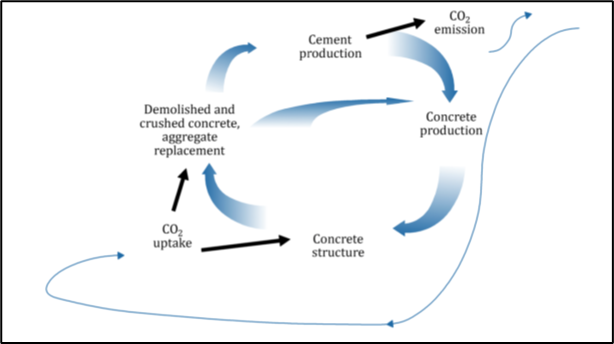
Figure 1: CO₂ cycle in cement and concrete (source: EN 16757)
Because concrete can reabsorb a meaningful share of the CO₂ emitted during production, recarbonation is an important factor in assessing the true carbon footprint of cement-based products. Accurate accounting can make a material difference when demonstrating low or net zero embodied carbon. However, the amount of uptake depends heavily on in-service conditions that only the designer and building owner can specify. More accurate whole-life assessment therefore needs that knowledge to be built in.
3. The current standards: EN 15804 and EN 16757 (the Now)
3.1 EN 15804 and core LCA rules
EN 15804 sets the core rules for EPDs of construction products. It defines the life cycle modules (A1 to A5 for product and construction, B1 to B7 for use, C1 to C4 for end of life, and D for benefits and loads beyond the system boundary) and requires impact indicators to be reported in a standard format.
EN 15804 recognises CO₂ uptake by carbonation and allows it to be included in the life cycle modules, provided the assumptions and methods are clearly documented.
3.2 EN 16757 and concrete-specific rules
EN 16757 adds detailed Product Category Rules for concrete and concrete elements. Its annex on CO₂ uptake by carbonation (Annex G in the current edition) gives guidance on calculating uptake based on carbonation depth, reactive CaO content, cement composition, exposure and service life.
The method models carbonation depth as proportional to the square root of time. The rate is set by a k factor that depends on exposure and concrete strength: stronger concrete carbonates more slowly, and concrete exposed to rain carbonates at a different rate from sheltered or indoor concrete. Carbonation depth is then converted into a mass of CO₂ using the reactive CaO content, cement content and binder composition.
EN 16757 considers carbonation in modules B (use), C3 (waste processing) and C4 (disposal), and in A3 for precast products stored before delivery. Each module relies on assumptions about exposure, duration and surface area, which reflects the fact that these are often unknown at product level.
4. How the GCCA EPD Tool models recarbonation
4.1 Overview
Both standards treat recarbonation as optional, provided any exclusion is clearly stated, but both encourage its inclusion. The GCCA has made it standard practice in its EPD Tool.
The GCCA EPD Tool follows the EN 16757 guidance and calculates CO₂ uptake in modules A3 (precast storage), B (use), C3 (crushed concrete stored before recycling) and C4 (landfilled concrete). Throughout the life cycle, each stage accounts for the recarbonation that has already happened in earlier stages, which reduces the share of concrete still available to carbonate.
The results are reported in the EPD in the extra indicator "Emissions from calcination and removals from carbonation", in line with ISO 21930.
For each module, the tool combines two sets of parameters: product-specific parameters, such as binder composition, reactive CaO and strength, which the producer knows; and module-specific parameters, such as exposure, duration and geometry, which the producer often does not know. This split is key to understanding both today's product-level approach and the opportunity for BIM discussed later.
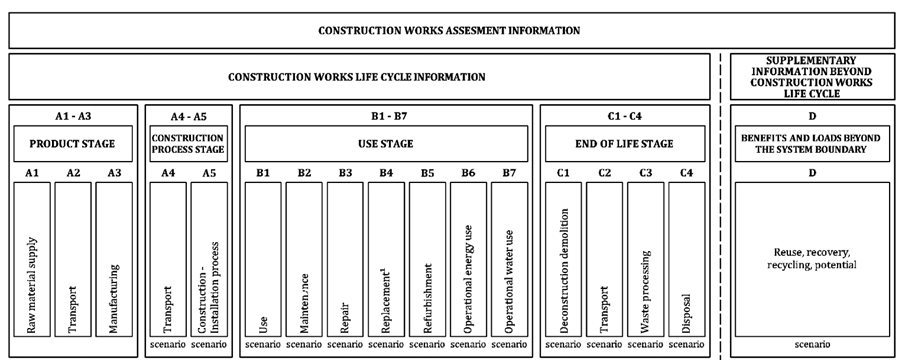
Figure 2: Life cycle stages and modules (source: EN 15804)
4.2 The calculation method
For the use stage, the tool applies the EN 16757 formula for CO₂ uptake per square metre of exposed surface:

where d is the carbonation depth in mm:
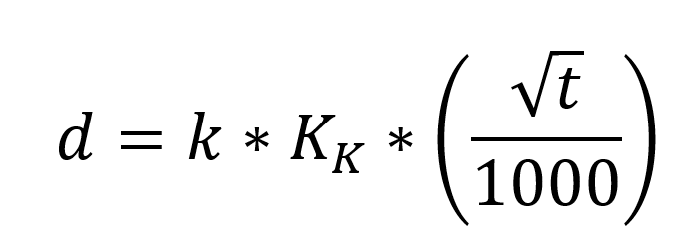
The other terms are:
| Term | Meaning | Unit | Depends on |
|---|---|---|---|
| w | Share of reactive CaO | kg CaO/kg binder | Cement type |
| Cc | Mass of binder (clinker) | kg/kg cement | Cement type |
| mCO₂/mCaO | Ratio of the molar masses of CO₂ and CaO | - | Constant |
| k | k factor for carbonation depth | mm/year0.5 | Exposure and concrete strength |
| t | Time of exposure | years | Use scenario |
| Dc | Degree of carbonation | % | Exposure |
| C | Cement content of the concrete | kg/m³ concrete | Mix design |
| KK | Correction factor for the k factor | - | Amount of constituents other than clinker (such as limestone, silica fume, fly ash, blast furnace slag) |
Table 1: Terms used in the recarbonation formula (source: GCCA EPD Tool LCA Model report, Version 6)
The same method is used for precast storage in A3, with storage-specific exposure and duration. At end of life, the tool assumes the demolished concrete is crushed into spherical particles and applies the same method to radial carbonation around each particle.
The product-specific inputs are:
- Share of reactive CaO: default value of 65%, from EN 16757
- Concrete strength class: entered on the "Product description" page
- Constituents other than clinker in the concrete: entered on the "Product description" page
- Exposed surface per unit volume (m²/m³): entered on the "Use" page
4.3 Three approaches
Producers have very different levels of knowledge about how their products will be used, so the tool offers up to three approaches for each life cycle stage.
Detailed approach
For users who know the exposure conditions, duration and geometry:
- Precast storage (A3): the user enters the storage duration, exposure conditions and exposed surface area per cubic metre.
- Use (B): the user enters the service life, selects the exposure conditions and selects the type of structure the concrete is used in.
- Waste processing (C3): the user enters how long crushed concrete is stored before reuse and selects the exposure conditions. The tool assumes spherical particles of 150 mm diameter.
- Disposal (C4): no detailed approach; the default approach applies.
In line with EN 16757, the exposure conditions are: exposed to rain, sheltered, indoor in dry climate with cover, indoor in dry climate without cover, in ground, and under groundwater level. If the exposure is unknown, the tool selects the option that minimises recarbonation, excluding the in-ground options: "indoor in dry climate with cover" for strength classes below 15 MPa, and "exposed to rain" for all others.
Default approach
For users with little or no information about how the product will be used. The defaults follow the simplified methods in EN 16757:
- Precast storage (A3): no default approach; the detailed approach applies.
- Use (B): the user selects the type of structure. For concrete with an exposed surface area of more than 8 m²/m³, uptake is estimated as the maximum theoretical uptake per kg of cement × 0.15 × the cement content. For lower surface areas, EN 16757 gives the indicative values in Table 2, and users can enter a value through the user-defined approach.
- Waste processing (C3) and disposal (C4): a total end-of-life uptake of 5 kg CO₂ per declared unit is split between C3 and C4 according to the recycling rate. For example, with 80% recycling, 4 kg CO₂ is assigned to C3 (5 × 0.8) and 1 kg CO₂ to C4 (5 × 0.2).
| Cylinder strength class (MPa) | 16 to 20 | 25 to 35 | Above 35 |
|---|---|---|---|
| Surface/volume ratio up to 3 m²/m³ | 7.5 | 6.5 | 5 |
| Surface/volume ratio above 3 and below 8 m²/m³ | 15 | 13 | 10 |
Table 2: Indicative CO₂ uptake of concrete and concrete elements with low surface-to-volume ratios, in kg CO₂/m³ (source: EN 16757, as reported in the GCCA EPD Tool LCA Model report, Version 6)
User-defined approach
For modules B, C3 and C4, users can enter their own CO₂ uptake value per declared unit, based on their own calculations, national requirements or a company-specific model. This suits producers with regional carbonation data or special product types.
In all cases, the tool recalculates recarbonation as the user makes choices and shows the result at the bottom of each page.
5. The limits of product-level accounting
EN 16757 acknowledges a basic constraint: producers do not know the exposure, surface area or service life of their concrete in any specific building. The standard deals with this through generic scenarios and transparent assumptions.
Designers and clients, however, know or can specify:
- where each concrete element is and its exposure (interior, protected exterior, exposed facade, below ground)
- whether surfaces are painted, plastered or finished with low-permeability coatings
- the design service life of the building
- the real dimensions and surface configuration of each element
- the expected end-of-life route (landfill, reuse, or crushing for recycled aggregate)
This information is not available when the EPD is produced, but it becomes available during design and should inform the building-level carbon assessment.
6. The case for BIM integration (the Next)
Building Information Modelling (BIM) offers a way to combine the producer's EPD data with the designer's knowledge of use conditions. In a BIM model:
- each concrete element is modelled with its real geometry
- surface areas, volumes and surface-to-volume ratios are calculated automatically
- each element can be given attributes such as surface finish and design life
- exposure conditions can be set for spaces and surfaces
- the exposure class of each face of each element can be derived from its location
- material data for each element can be pulled from the project's digital EPDs, and the EN 16757 method applied with project-specific use data
The result is a project-specific calculation that follows the EN 16757 method but reflects the real building geometry, exposure and use.
For this to work, digital EPDs for concrete must provide the parameters the standard needs in a machine-readable format. They should also state any recarbonation already claimed, so that designers do not double count or apply conflicting assumptions.
A BIM-integrated tool could then report:
- Annual CO₂ uptake during the use phase
- Total use-phase uptake over the design service life
- End-of-life uptake (C3 and C4), shown separately so the effect of recycling assumptions is visible
- An element-by-element breakdown, showing where uptake is concentrated and where better data would help
- Sensitivity analysis, for example changing design life, exposure, finishes or product choice, without compromising safety or durability
- Whole-life carbon for the project, combining embodied carbon, operational energy and recarbonation
Today, EPD formats have no dedicated fields for carbonation-specific material parameters. Adding them would let BIM tools extract the data reliably, rather than BIM users searching each EPD by hand.
7. Recommendations: implementing the Now and preparing for the Next
CO₂ uptake through recarbonation is significant and should be recognised and quantified much more widely in concrete carbon assessments. Recarbonation is not generally included in North American practice, and some producers elsewhere choose not to report it even when they could. As an immediate step, GCCA recommends including recarbonation in EPDs in all regions, using consistent whole-life methods. Over the medium to long term, the sector should move towards project-level calculation, enabled by BIM, so that uptake reflects the actual use, exposure and geometry of each structure.
- North American PCRs: the EN 15804 and EN 16757 framework is well established in Europe but not yet included in North American standards or PCRs. Standards bodies and PCR committees should extend assessments to full cradle to grave and include recarbonation.
- Producer training and uptake: producers should be encouraged, or required, to declare recarbonation in their EPDs.
- Building LCA tools: BIM-integrated LCA tools should accept EN 16757 recarbonation inputs so designers can assess uptake at building level.
- Standard data fields in digital EPDs: EPD programme operators should define a standard, machine-readable set of fields for concrete recarbonation in next-generation digital EPD formats.
- Project-level calculation in BIM: BIM software should calculate recarbonation at project level using data from digital EPDs.
8. Conclusion
Recarbonation is a significant CO₂ uptake that belongs in whole-life carbon accounting for concrete products and buildings. EN 15804 and EN 16757 provide a method for product-level accounting, and the GCCA EPD Tool applies it, with detailed, default and user-defined options.
But producers cannot know the exposure, surface area and service life of their concrete in a specific building, so EPDs rely on generic defaults. These are conservative to keep EPDs credible, but they can miss the variation in real projects.
Combining producers' EPD data with designers' and clients' knowledge of the building, through BIM-enabled whole-life carbon tools, would make recarbonation visible, credible and something designers can act on. It would support the concrete sector's path to net zero and allow more accurate comparisons between concrete and other materials.
Read more about the BIM approach in Recarbonation at Project Level: Using BIM for Concrete's CO₂ Uptake, or request a demonstration of the GCCA EPD Tool.
References
CEN (2019). EN 15804:2012+A2:2019 Sustainability of construction works. Environmental product declarations. Core rules for the product category of construction products.
CEN. EN 16757 Sustainability of construction works. Environmental product declarations. Product Category Rules for concrete and concrete elements.
Global Cement and Concrete Association (2026). GCCA Industry EPD Tool for Cement and Concrete: LCA Model, International version, v6.0.
Stripple, H., Ljungkrantz, C., Gustafsson, T. and Andersson, R. (2018). CO₂ uptake in cement-containing products: Background and calculation models for IPCC implementation. IVL Swedish Environmental Research Institute.
The Concrete Centre. Carbonation of concrete.